


 Superb Material
★★★★★
Amazing Quality
“Very good indeed, the product well packaged. I recommend the product for people having difficulty gaining balance.”


A physio-developed, 5-minute morning balance routine, done standing at your kitchen counter.
Trains the balance you rely on every day
Developed by Sophiaa Durrell, physiotherapist
No floor work. Hold on as much as you need
Pad, grip socks, fridge card & video included
Couldn't load pickup availability
Use it most mornings. Not feeling steadier within 100 days? Full refund, no forms.
 100-Day Steadiness Promise
 Developed by a physiotherapist
 Free tracked delivery, 4–10 days
Walk through your own home without reaching for the furniture.
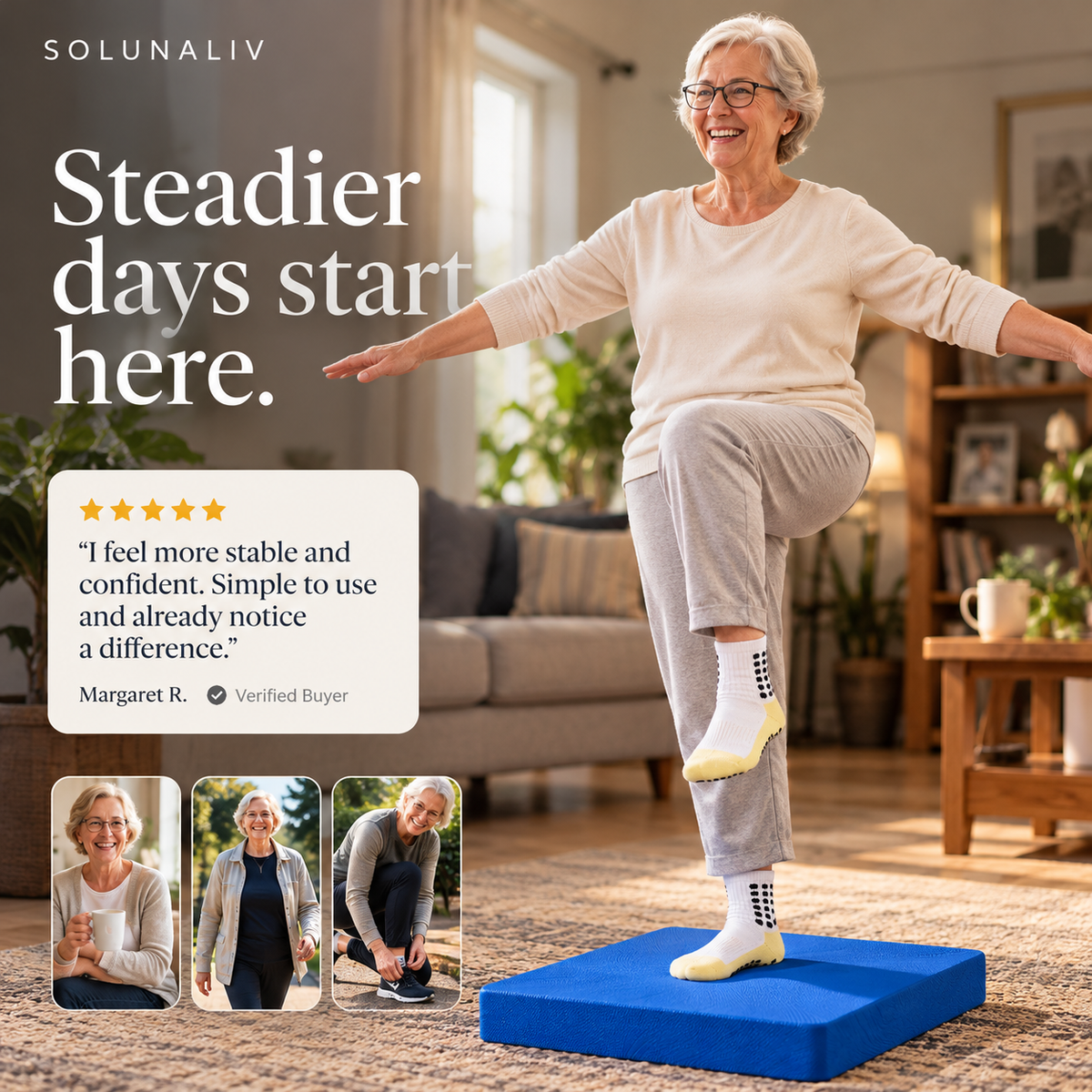
Balance can be trained at any age. Balance exercise is one of the best-proven ways to stay on your feet. The Footing Pad turns it into a simple morning habit beside your kitchen counter, with no gym, no waiting list and no getting down on the floor.
Use it most mornings. If you don't feel steadier and more confident within 100 days, email help@solunaliv.com for a full refund. No forms, no fuss.
The routine was developed by Sophiaa Durrell, physiotherapist, and every exercise is done standing beside a counter or sturdy chair. In the first week you simply stand on the pad, holding on as much as you need. There's no jumping, kneeling, floor work or standing on one foot. Start with the grip socks on. If you've had a recent fall or surgery, get dizzy when you stand, or have a medical condition, check with your GP or doctor first.
Free tracked delivery to the UK (4–9 days), Canada (5–8 days) and Australia (6–10 days). Your routine video arrives by email as soon as you order.
2-pack: both bundles come in the colours you choose. Want different colours? Add two single bundles to your basket.



If you nodded at two or more, you're not alone, and you're not imagining it. Your balance has started asking for help. The good news: it responds to training at any age.
Around 1 in 3 people over 65 in the UK has a fall each year, rising to around half of over-80s.
Source: Age UK; NICE
Your balance depends on a fast loop: your feet sense the ground, your brain reads it and your muscles correct you in a split second. Like any skill, that loop weakens when it isn't used. Here is how it usually happens.
A near-miss on a step or a moment of dizziness when you stand up.
You hold on, take shorter steps and keep your feet low. It feels sensible.
Fewer walks, fewer outings. Your balance gets less practice than ever.
Less practice means less balance. That brings more wobbles, and the cycle tightens.
This cycle is common. In one study of older adults living at home, nearly 6 in 10 said they were afraid of falling, and a third had cut back on activities because of it. That included many people who had never fallen.
fewer falls
That was the result for balance and functional exercises in a Cochrane review of 39 trials and about 7,900 older adults living at home. The reviewers rated the evidence high-certainty.
sooner, on a foam surface
In a randomised trial with older adults, training on a foam pad improved balance test scores about two months earlier than the same training on a flat floor.
is where it works
The programmes that reduce falls are mostly done standing and copy everyday movements, like rising from a chair or climbing stairs. That is how the Footing routine is built.
These figures come from published studies of balance training programmes, not trials of the Footing Pad itself. Programmes with more practice each week showed the biggest benefits. That's why the routine starts with five minutes and shows you how to add short practice to moments you already have.

Standing on soft, supportive foam makes your feet and ankles correct you constantly. Each small correction is a repetition for the loop that keeps you upright. You stay beside the counter the whole time, holding on as much as you like.
The pad gives you the challenge. The routine gives you the progression, starting with simply standing and building gradually. Grip socks keep every step on and off secure.
Get my Footing PadStaying on your feet also keeps the rest of you going: the walks, the shopping, the visits and the independence of running your own home. Movement keeps you moving.
Most balance pads come without a plan, so they end up in a cupboard. The Footing Pad comes with a routine you'll actually keep.

40 × 33 cm, 5 cm thick. Soft, resilient TPE foam with a diamond-textured non-slip surface. In Charcoal, Blue or Pink.

Gentle standing exercises in four stages, developed by Sophiaa Durrell, physiotherapist. You get a large-print card for the fridge and a follow-along video, emailed as soon as you order. It also includes "moments": ways to practise while the kettle boils or you brush your teeth.

Breathable, with silicone grip soles so stepping on and off the pad feels secure. In White or Black.
This is a typical path. Everyone is different, and doing it most mornings matters more than anything else.
Just stand on the pad and hold the counter. Your feet feel busy straight away. That's the loop waking up.
You start the routine. The pad feels familiar, and you may need the counter a little less.
This is the window in which balance test scores improved in the foam-pad trial. Everyday moments can start to feel less calculated.
It becomes part of your morning, like the kettle. Keep going to keep the benefit.
| What people try | The catch | With the Footing Pad |
|---|---|---|
| Being extra careful | Slows you down and feeds the cycle | Practises balance every morning |
| Walking more | Great for health, but research is unclear on whether walking alone prevents falls | Targets balance directly, the type of exercise with the strongest evidence |
| Waiting for physio | Waiting lists, travel and sessions that end | Start tomorrow and keep going, alongside any care you receive |
| A stick or walker | Valuable support, but it doesn't train balance | Works on the steadiness underneath |
| A pad on its own | No plan, so it ends up in the cupboard | A staged routine, a fridge card and a video to follow |
IN THEIR WORDS
Superb Material“Very good indeed, the product well packaged. I recommend the product for people having difficulty gaining balance.”
 Morning Routine
“Happy to tell you my mum has regained her balance in 5 weeks. She only uses the pad for about 10 mins everyday, and follows the routine that came with it. Now she can walk without the walking stick, i didn't think it was possible at her age. Worth every penny & more.”
 True to Size
“Vey good yoga or gym cushion pad. Very satisfied. My mother feels different”
 Less Pressure on knees
“My Dad is 89 , and has had atrophied legs from prolonged bed rest as a child. Since he is using the pad every morning , 5 mins a day, he definitely feels less burden on the knees.”
 Good Quality
“Excellent quality, good softness for balance or kneeling. Amazing buy”
 Exceptional Quality
“The non-slip foam mat provides good stability for balance, core and strength exercises. Comfortably soft, yet shape retaining foam - ideal for knees and ankles. The surface adheres securely to smooth floors, hardly slips. Bought it for my mom, but even i use it. Love it”
 Everyday comfort
“Large, almost the same quality as they use in physical therapy practice, well packaged. Good price and fast shipping.”
100-Day Steadiness Promise
Shop Soluna Footing
You can't be there every morning, but this can. It arrives in a box worth giving, ready to hand over. It's a kind way to say "I want you steady on your feet" without it feeling like a lecture.
Tip: choose "Me and someone I love" and get one for each of you. It's easier to keep a morning habit going together.
Send one as a giftFive minutes is where you start, because a habit you keep beats a plan you abandon. Research shows that more practice each week brings bigger benefits, so the routine also shows you short ways to add practice to moments you already have, like waiting for the kettle or brushing your teeth.
It has a non-slip base. Place it on carpet or a rug and wear the grip socks, and stepping on and off feels secure.
Not at all. Put on the socks and stand on the pad next to the counter. That's day one. The routine comes as a large-print card for the fridge, and the video is there if you'd like it.
Many people say the pad feels familiar within a week or two. In the foam-pad research, balance test scores improved over the first months of regular training. Everyone is different, and consistency matters most.
Many people with ongoing conditions include balance training in their routine, but every situation is different. Please speak to your GP or physiotherapist before starting, and use the Footing Pad alongside any care you already receive.
It sits quietly by the counter for a few minutes each morning. What people notice is that you're walking with your head up again.
You have 100 days. If you don't feel steadier and more confident, email help@solunaliv.com for a full refund. No forms, no fuss.
The best time to train your balance is before you need it. Five minutes, your own kitchen, and 100 days to feel the difference.
Get my Footing PadSources. Sherrington C et al., Exercise for preventing falls in older people living in the community, Cochrane Database of Systematic Reviews, 2019. Effects of a balance training program using a foam rubber pad in community-based older adults: a randomized controlled trial, Journal of Geriatric Physical Therapy, 2015;38(2):62–70. Fear of falling and associated activity restriction in older people, Archives of Public Health. Age UK; National Institute for Health and Care Excellence (NICE), falls guidance.
The Footing Pad is a balance training aid, not a medical device. It is not intended to diagnose, treat or prevent any condition. If you have a health condition or have had a recent fall or surgery, please speak to your doctor, GP or physiotherapist before starting a new exercise routine.